

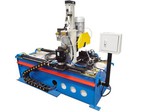

Can a Laser Tube Welding Machine Be Used for Welding Tubes with Different Melting Points?
As a supplier of Laser Tube Welding Machines, I often encounter questions from customers about the machine's capabilities, especially regarding its use for welding tubes with different melting points. In this blog post, I will delve into the technical aspects of laser tube welding and explore whether it can effectively handle tubes with varying melting points.


Understanding Laser Tube Welding
Laser tube welding is a highly precise and efficient welding method that utilizes a high - energy laser beam to melt and fuse the materials at the joint. The laser beam is focused on the welding area, generating intense heat that quickly melts the metal, allowing for a strong and seamless bond. One of the key advantages of laser tube welding is its ability to provide a high level of control over the welding process, including the heat input, welding speed, and penetration depth.
Challenges of Welding Tubes with Different Melting Points
When dealing with tubes that have different melting points, several challenges arise. The primary issue is ensuring that both materials reach their melting points simultaneously to form a proper weld. If one material melts too quickly while the other remains solid, it can lead to an uneven weld, weak joints, or even complete failure of the weld.
For example, consider a scenario where we need to weld a tube made of copper (melting point around 1085°C) to a tube made of stainless steel (melting point around 1375 - 1530°C). The significant difference in melting points makes it difficult to achieve a uniform weld using traditional welding methods.
Can a Laser Tube Welding Machine Overcome These Challenges?
The answer is yes, a laser tube welding machine can be used for welding tubes with different melting points, but it requires careful consideration and optimization of the welding parameters.
1. Precise Heat Control
Laser tube welding machines offer precise control over the heat input. By adjusting the laser power, pulse duration, and frequency, it is possible to heat each material to its melting point without overheating the other. For instance, if welding a high - melting - point material and a low - melting - point material, the laser can be programmed to deliver a higher energy density to the high - melting - point material while keeping the heat input to the low - melting - point material within a safe range.
2. Focused Energy Application
The laser beam can be precisely focused on the welding area, which means that the heat can be concentrated on the specific points where the two tubes meet. This focused energy application helps to minimize the heat affected zone (HAZ) and reduces the risk of overheating one of the materials.
3. Adaptable Welding Speeds
The welding speed can be adjusted according to the properties of the materials being welded. For materials with a large difference in melting points, a slower welding speed may be required to ensure that both materials have enough time to reach their melting points and form a proper bond.
Case Studies
Let's take a look at some real - world examples of using a laser tube welding machine to weld tubes with different melting points.
In a manufacturing plant, they needed to weld an aluminum tube (melting point around 660°C) to a titanium tube (melting point around 1668°C). By carefully adjusting the laser parameters, such as increasing the laser power and reducing the welding speed when approaching the titanium tube, they were able to achieve a strong and reliable weld. The key was to ensure that the aluminum did not overheat while the titanium reached its melting point.
Comparing with Other Welding Machines
There are other types of tube welding machines available in the market, such as Plasma Tube Welding Machine | Dual - Mode Precision Welder for Metal Pipes, TIG Tube Welding Machine | Precision Argon Arc Welder for Metal Pipes. While these machines also have their own advantages, laser tube welding machines have some unique benefits when it comes to welding tubes with different melting points.
Plasma tube welding machines use a high - temperature plasma arc to melt the materials. However, they may have more difficulty in precisely controlling the heat input, especially when dealing with materials with large differences in melting points. TIG tube welding machines use an electric arc and a non - consumable tungsten electrode. Although they offer good control, they may not be as fast or as precise as laser tube welding machines in some cases.
Tips for Successful Welding of Tubes with Different Melting Points
- Material Preparation: Ensure that the tubes are clean and free from contaminants before welding. Any dirt or oxide layers can affect the welding quality.
- Welding Parameter Optimization: Conduct test welds to determine the optimal laser power, pulse duration, frequency, and welding speed for the specific materials being welded.
- Joint Design: Choose an appropriate joint design that allows for better heat transfer and fusion between the two materials.
Conclusion
In conclusion, a laser tube welding machine can indeed be used for welding tubes with different melting points. Its precise heat control, focused energy application, and adaptable welding speeds make it a viable option for this challenging task. However, it requires careful planning, parameter optimization, and material preparation to achieve successful welds.
If you are interested in our Laser Tube Welding Machine | Precision CNC Welding for Metal Tubes or have any questions about welding tubes with different melting points, please feel free to contact us for further discussion and procurement negotiations.
References
- "Principles of Laser Materials Processing" by John C. Ion
- "Welding Metallurgy" by R. W. Messler Jr.