


Automation has become a cornerstone in modern manufacturing, and the decorative tube mill industry is no exception. As a supplier of decorative tube mills, I've witnessed firsthand how automation has transformed the way we produce high - quality tubes. In this post, I'll delve into the automation level of a modern decorative tube mill, exploring its features, benefits, and the impact on the industry.
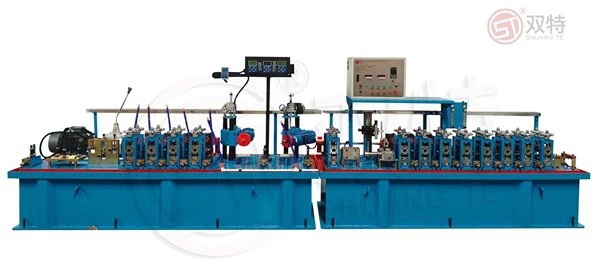

The Basics of Automation in Decorative Tube Mills
Automation in a decorative tube mill refers to the use of advanced technologies and control systems to perform various manufacturing processes with minimal human intervention. These processes typically include coil feeding, strip leveling, tube forming, welding, sizing, and cutting. By automating these steps, we can achieve greater precision, efficiency, and consistency in tube production.
One of the key components of an automated decorative tube mill is the programmable logic controller (PLC). The PLC acts as the brain of the system, controlling the operation of motors, sensors, and other devices. It allows for precise control of parameters such as speed, tension, and weld quality, ensuring that each tube meets the specified requirements.
Another important aspect of automation is the use of servo - driven systems. Servo motors are highly precise and can be controlled accurately to adjust the position, speed, and torque of various machine components. This enables the tube mill to produce tubes with tight tolerances and smooth surfaces, which are essential for decorative applications.
Coil Feeding and Strip Leveling
The first stage of tube production is coil feeding and strip leveling. In a modern automated decorative tube mill, the coil is loaded onto a decoiler, which unwinds the strip at a controlled speed. The strip then passes through a leveling machine, which removes any curls or bends.
Automated coil feeding systems use sensors to monitor the coil diameter and the tension of the strip. This information is sent to the PLC, which adjusts the speed of the decoiler accordingly. As a result, the strip is fed into the mill at a constant rate, ensuring a smooth and continuous production process. The leveling machine is also automated, with the ability to adjust the pressure and the number of passes based on the thickness and material of the strip.
Tube Forming and Welding
Once the strip is leveled, it enters the tube forming section of the mill. In an automated system, the forming rolls are precisely adjusted by servo motors to gradually shape the strip into a tube. The forming process is carefully controlled to ensure that the tube has a uniform diameter and wall thickness.
Welding is a critical step in the production of decorative tubes. Modern decorative tube mills often use high - frequency induction welding (HFIW). The automated welding system monitors the welding parameters, such as the welding current, voltage, and speed, in real - time. If any deviation from the set values is detected, the PLC automatically adjusts the parameters to maintain the quality of the weld. This ensures that the weld is strong, smooth, and aesthetically pleasing.
Sizing and Cutting
After welding, the tube passes through a sizing section, where it is further shaped to achieve the final dimensions. The sizing rolls are also servo - driven, allowing for precise adjustment according to the required tube size.
Automated cutting systems use a flying saw or a laser cutter to cut the tube to the desired length. These systems are synchronized with the production speed of the mill, ensuring that the cuts are accurate and clean. The cutting length can be easily programmed into the PLC, and the system can automatically compensate for any variations in the tube speed.
Quality Control and Monitoring
Automation in decorative tube mills also plays a crucial role in quality control. Throughout the production process, various sensors are installed to monitor the quality of the tubes. For example, sensors can detect defects such as cracks, holes, or irregularities in the tube surface.
In addition, non - destructive testing (NDT) techniques, such as ultrasonic testing and eddy - current testing, can be integrated into the automated system. These tests can detect internal defects in the tube, ensuring that only high - quality tubes are produced.
The data collected from these sensors and tests is sent to a central control system, where it can be analyzed in real - time. If any quality issues are detected, the system can automatically stop the production line and alert the operators, allowing for immediate corrective action.
Benefits of High - Level Automation
The high - level automation of modern decorative tube mills offers numerous benefits. Firstly, it significantly improves the production efficiency. With automated processes, the mill can operate at a higher speed and with less downtime, resulting in a higher output.
Secondly, automation enhances the product quality. By precisely controlling the manufacturing parameters and conducting thorough quality control, the tubes produced are more consistent in terms of dimensions, surface finish, and mechanical properties.
Thirdly, automation reduces labor costs. Since many processes are automated, fewer workers are required to operate the mill. This not only saves on labor expenses but also reduces the risk of human error.
Moreover, automation improves workplace safety. By minimizing human intervention in dangerous or repetitive tasks, the risk of accidents and injuries is significantly reduced.
Industry Impact
The high level of automation in decorative tube mills is reshaping the industry. It is making it possible for manufacturers to produce tubes faster, better, and at a lower cost. This has led to increased competition in the market, as companies strive to offer high - quality products at competitive prices.
Automation is also driving innovation in the decorative tube industry. Manufacturers are constantly looking for new ways to improve their automated systems, such as integrating more advanced sensors and control algorithms. This is leading to the development of new types of decorative tubes with enhanced features and performance.
Our Product Range
As a supplier of decorative tube mills, we offer a wide range of products to meet the diverse needs of our customers. Our Public Facility Stainless Steel Tube Mill | Tube Making Machine for Urban Infrastructure is specifically designed for the production of tubes used in public facilities, such as handrails, guardrails, and street furniture. It features high - level automation and can produce tubes with excellent corrosion resistance and aesthetic appeal.
Our Industrial - Grade Stainless Steel Construction Tube Mill Machine Manufacturer is suitable for industrial applications, such as building structures and machinery components. It is capable of producing large - diameter and high - strength tubes with high precision.
For those in the furniture industry, our Stainless Steel Furniture Tube Mill is the ideal choice. It can produce tubes with a smooth surface finish and a variety of shapes, meeting the strict design requirements of modern furniture.
Contact Us for Purchase Negotiation
If you are interested in our decorative tube mills and would like to learn more about our products or have any specific requirements, we welcome you to contact us for purchase negotiation. We are committed to providing you with high - quality products, excellent customer service, and competitive prices.
References
- Machinery's Handbook, Industrial Press Inc., 31st Edition.
- "Automation in the Metalworking Industry", ASM International.
- Journal of Tube Production Technology, various issues.