

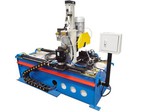

Hey there! As a supplier of Laser Tube Welding Machines, I've seen a lot of action in the tube welding world. Today, I'm gonna break down how a laser tube welding machine stacks up against resistance welding machines in tube welding.
Let's start with the basics. Resistance welding is a pretty old - school method. It works by passing an electric current through the parts to be welded. The resistance to the current generates heat, which then melts the metal and fuses the pieces together. It's been around for ages and has been used in all sorts of industries, from automotive to construction.
On the other hand, laser tube welding is a more modern approach. A laser tube welding machine uses a high - intensity laser beam to melt and join the metal tubes. The laser can be precisely controlled, allowing for very accurate and clean welds.
Weld Quality
One of the biggest differences between the two is the quality of the welds. With resistance welding, the heat is generated across a relatively large area. This can lead to some distortion in the tubes, especially if the welding parameters aren't set just right. There can also be issues with uneven heating, which might result in weak spots in the weld.
In contrast, a Laser Tube Welding Machine | Precision CNC Welding for Metal Tubes offers extremely high - quality welds. The laser beam is focused on a very small area, which means less heat is transferred to the surrounding metal. This results in minimal distortion and a much more consistent weld. The precision of the laser also allows for better control over the weld bead, making it ideal for applications where aesthetics and strength are both important.
Speed and Efficiency
When it comes to speed, laser tube welding machines have a clear edge. Resistance welding can be a bit slow, especially when dealing with thicker tubes. The process requires time to build up enough heat to melt the metal, and then there's the cooling time.
Laser tube welding, however, is much faster. The high - energy laser beam can quickly melt the metal, and the welding process can be completed in a fraction of the time. This increased speed means higher productivity, which is a huge advantage for manufacturers who need to produce a large number of welded tubes.
Cost
Cost is always a major consideration in any manufacturing process. Resistance welding machines are generally less expensive to purchase. They have been around for a long time, and the technology is well - established, so the equipment is more affordable.
But we need to look at the long - term costs too. Laser tube welding machines, while more expensive upfront, can save money in the long run. They require less post - welding finishing work because of the high - quality welds they produce. Also, the increased speed and efficiency mean that you can produce more tubes in less time, which can offset the initial investment.
Flexibility
Resistance welding machines are great for simple, straightforward tube welding jobs. They work well with a variety of metals and can handle different tube sizes. However, they can be a bit limited when it comes to complex geometries or small - scale welding.
Laser tube welding machines, on the other hand, are much more flexible. The laser beam can be easily adjusted to fit different tube shapes and sizes. It can also be used for welding in hard - to - reach areas. This makes it a great choice for industries that require custom - made tubes or have complex welding requirements.
Safety
Safety is a crucial aspect of any welding process. Resistance welding involves high - voltage electricity, which can be dangerous if not handled properly. There's also the risk of electric shock and burns.
Laser tube welding machines have their own safety concerns, but they are generally considered safer. The laser is enclosed in a protective housing, which reduces the risk of accidental exposure. And since there's no open flame or high - voltage electricity, the risk of fire and electric shock is significantly reduced.
Applications
Resistance welding is commonly used in industries like automotive manufacturing, where large - scale production of simple tube assemblies is required. It's also used in the construction industry for welding structural tubes.


Laser tube welding is finding its way into a wide range of industries. It's popular in the aerospace industry, where high - precision and high - strength welds are essential. It's also used in the medical device industry for welding small, delicate tubes.
If you're in the market for a tube welding machine, you might also want to check out other options like the TIG Tube Welding Machine | Precision Argon Arc Welder for Metal Pipes and the Plasma Tube Welding Machine | Dual - Mode Precision Welder for Metal Pipes. Each of these machines has its own advantages and is suitable for different applications.
In conclusion, while resistance welding machines have their place in the tube welding world, laser tube welding machines offer a lot of benefits in terms of weld quality, speed, flexibility, and safety. If you're looking to take your tube welding to the next level, a laser tube welding machine might be the way to go.
If you're interested in learning more about our Laser Tube Welding Machines or want to discuss your specific welding needs, feel free to reach out. We're here to help you find the best solution for your business.
References
- Jones, R. (2018). Welding Technologies: A Comparative Analysis. Industrial Welding Journal.
- Smith, M. (2020). Advancements in Laser Welding for Tube Manufacturing. Journal of Manufacturing Science.