

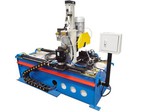

Hey there! As a supplier of Servo Tube Cutting Machines, I often get asked about how to measure the cutting quality of these machines. It's a crucial question, especially for those in the industry who rely on precise cuts for their projects. In this blog, I'll share some key factors and methods to help you assess the cutting quality of a servo tube cutting machine.
Surface Finish
One of the first things you'll notice when evaluating the cutting quality is the surface finish of the cut tube. A smooth and clean surface finish is a sign of a high - quality cut. Rough or uneven surfaces can indicate problems with the cutting process.
When it comes to measuring surface finish, there are a few ways to do it. One common method is using a surface roughness tester. This device measures the microscopic irregularities on the surface of the cut tube. The results are usually given in units like micrometers (μm) or microinches (μin). For most applications, a lower surface roughness value means a better - quality cut.
Another way to visually assess surface finish is by using a magnifying glass. Look for any signs of burrs, chips, or scratches on the cut surface. Burrs are small, rough edges that can form during the cutting process. They can be a nuisance, especially if the tube needs to be welded or connected to other components later on. A good servo tube cutting machine should produce cuts with minimal burrs.
Dimensional Accuracy
Dimensional accuracy is another critical aspect of cutting quality. It refers to how closely the actual dimensions of the cut tube match the desired dimensions. Inaccurate cuts can lead to fitting problems, which can be costly and time - consuming to fix.
To measure dimensional accuracy, you'll need some precision measuring tools. A caliper is a handy tool for measuring the outer diameter, inner diameter, and wall thickness of the tube. You can measure these dimensions at multiple points along the cut tube to ensure consistency.
For length measurements, a measuring tape or a precision length gauge can be used. The tolerance for length accuracy depends on the specific application. In some industries, a tolerance of a few millimeters might be acceptable, while in others, it could be as tight as a few hundredths of a millimeter.
If the dimensional accuracy of the cuts is consistently off, it could be a sign of issues with the machine's control system, the cutting blade, or the clamping mechanism.
Cut Angle Accuracy
In many applications, the cut angle of the tube is just as important as the dimensional accuracy. For example, in the construction of frames or furniture, precise cut angles ensure a proper fit between the tubes.
A protractor can be used to measure the cut angle of the tube. However, for more accurate measurements, a digital angle gauge is a better option. It provides a more precise reading and can be easier to use, especially when dealing with small angles.
The servo tube cutting machine should be able to maintain a consistent cut angle across multiple cuts. Any variation in the cut angle can lead to misaligned joints and a weakened structure.
Kerf Width
The kerf width is the width of the material that's removed during the cutting process. It's an important factor to consider, especially when dealing with materials that are expensive or when tight tolerances are required.
To measure the kerf width, you can use a microscope or a high - resolution camera. Measure the width of the cut at multiple points along the length of the tube. The kerf width should be consistent across the entire cut.
A wider kerf width can mean more material waste, which can increase costs. On the other hand, a very narrow kerf width might indicate that the cutting blade is wearing out or that the cutting parameters are not set correctly.
Burr Formation
As mentioned earlier, burrs are a common issue in tube cutting. They can affect the functionality and appearance of the cut tube. Measuring burr formation is not as straightforward as measuring other factors, but there are some ways to assess it.
You can use a burr gauge to measure the height and width of the burrs. A burr gauge typically has a series of steps or slots of different sizes. You can compare the burrs on the cut tube to these steps to get an idea of their size.
Reducing burr formation is often a matter of optimizing the cutting parameters, such as the cutting speed, feed rate, and blade selection. A good servo tube cutting machine should be able to minimize burr formation through proper control of these parameters.
Heat - Affected Zone (HAZ)
When cutting tubes, especially with methods that generate heat, such as laser cutting, there is a heat - affected zone (HAZ) around the cut. The HAZ is the area where the material's properties have been changed due to the heat.
Measuring the HAZ can be done using metallurgical analysis techniques. This involves taking a sample of the cut tube and preparing it for microscopic examination. The size and characteristics of the HAZ can affect the strength and corrosion resistance of the tube.
For a servo tube cutting machine, minimizing the HAZ is important, especially in applications where the material's properties need to be preserved. Laser cutting machines, for example, are known for having a relatively small HAZ compared to other cutting methods. You can check out our Tube Laser Cutting Machine | Precision CNC Metal Tube Cutting if you're interested in a machine with a small HAZ.
Machine - Specific Considerations
Different types of servo tube cutting machines have their own unique features and considerations when it comes to measuring cutting quality.
For example, Servo Tube Cutting Machine | CNC - Controlled Precision Pipe Sizing Equipment uses a servo - controlled system to ensure precise cuts. These machines often have high - accuracy positioning and can be programmed to make complex cuts. When measuring the cutting quality of a servo tube cutting machine, you need to pay attention to the machine's programming accuracy and the repeatability of the cuts.
On the other hand, Saw Blade Tube Cutting Machine | Precision Pipe Sizing Equipment uses a saw blade to cut through the tube. The quality of the saw blade, its sharpness, and the cutting speed can all affect the cutting quality. You'll need to check for signs of blade wear, such as dullness or chipping, and make sure the cutting speed is appropriate for the material being cut.
Conclusion
Measuring the cutting quality of a servo tube cutting machine is a multi - faceted process. It involves assessing factors like surface finish, dimensional accuracy, cut angle accuracy, kerf width, burr formation, and the heat - affected zone. By using the right measuring tools and techniques, you can ensure that the cuts made by your machine meet the required standards.
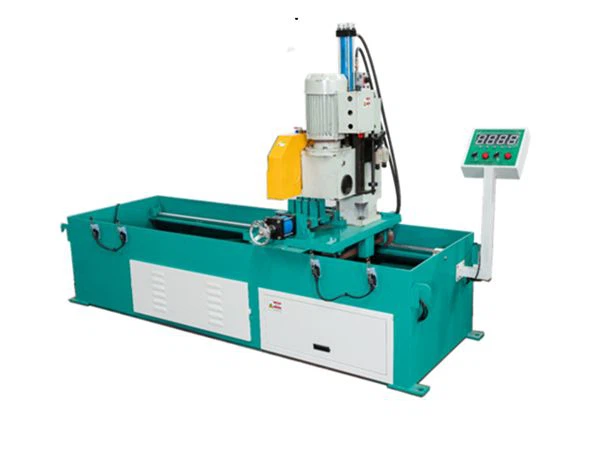

If you're in the market for a high - quality servo tube cutting machine or need more information on how to improve the cutting quality of your existing machine, don't hesitate to reach out. We're here to help you find the best solution for your needs. Whether you're a small workshop or a large manufacturing plant, our machines are designed to provide precise and reliable cuts. Contact us today to start discussing your procurement needs and let's work together to take your tube - cutting operations to the next level!
References
- ASME B89.1.12 - 2010, Surface Texture (Surface Roughness, Waviness, and Lay) - Measurement of Surface Roughness
- ISO 1101:2017, Geometric product specifications (GPS) - Geometric tolerancing - Tolerances of form, orientation, location and run - out