


In the manufacturing industry, the automation level of a decorative tube mill is a crucial factor that significantly impacts production efficiency, product quality, and overall competitiveness. As a supplier of decorative tube mills, I have witnessed firsthand the evolution and importance of automation in this field.
Understanding the Basics of a Decorative Tube Mill
Before delving into the automation level, it's essential to understand what a decorative tube mill is. A decorative tube mill is a specialized piece of equipment used to manufacture various types of decorative tubes. These tubes are widely used in different industries, such as public facilities, furniture, and construction. For instance, in public facilities, stainless - steel tubes are used for handrails, guardrails, and other structural elements. You can learn more about the tube mill for public facilities at Public Facility Stainless Steel Tube Mill | Tube Making Machine for Urban Infrastructure. In the furniture industry, stainless - steel tubes are used to create modern and stylish furniture pieces, and the relevant tube mill can be found at Stainless Steel Furniture Tube Mill. In construction, industrial - grade stainless - steel tubes are used for building frameworks and other structural components, and more information about the corresponding tube mill is available at Industrial - Grade Stainless Steel Construction Tube Mill Machine Manufacturer.
Components of a Decorative Tube Mill
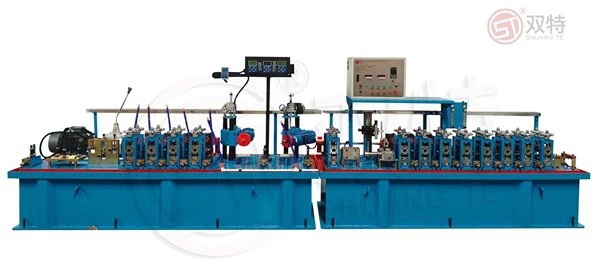
A typical decorative tube mill consists of several key components, including the decoiler, straightener, roll forming unit, welding unit, sizing unit, and cutting unit. Each of these components plays a vital role in the tube - making process.
The decoiler is responsible for unwinding the metal coil, which is the raw material for tube production. In a highly automated tube mill, the decoiler can be equipped with sensors and control systems to ensure a smooth and consistent unwinding process. It can automatically adjust the tension of the coil, preventing it from over - or under - unwinding, which could lead to production errors.
The straightener is used to straighten the metal strip after it is unwound from the coil. Automation in the straightener allows for precise adjustment of the straightening force based on the thickness and material properties of the strip. This ensures that the strip enters the roll - forming unit in a straight and flat condition, which is crucial for the quality of the final tube.
The roll - forming unit is where the metal strip is gradually formed into a tube shape. In an automated roll - forming process, the rolls can be adjusted automatically according to the desired tube diameter and wall thickness. Advanced control systems can monitor the forming process in real - time, making adjustments to the roll positions and pressures to ensure accurate and consistent tube dimensions.
The welding unit is used to weld the edges of the formed tube together. Automation in the welding process can improve the quality and efficiency of welding. For example, automated welding systems can control the welding current, voltage, and speed precisely, resulting in strong and uniform welds. They can also detect and correct welding defects in real - time, reducing the need for manual inspection and rework.
The sizing unit is responsible for finalizing the dimensions of the welded tube. Automated sizing units can make precise adjustments to the tube diameter and roundness. They can use sensors to measure the tube dimensions continuously and make automatic corrections to ensure that the tubes meet the required specifications.
The cutting unit is used to cut the continuous tube into the desired lengths. In an automated cutting process, the cutting length can be set accurately, and the cutting operation can be synchronized with the production speed of the tube mill. This ensures that the cut tubes have consistent lengths and clean cut edges.
Levels of Automation in a Decorative Tube Mill
The automation level of a decorative tube mill can be classified into different levels, ranging from basic automation to full - scale automation.

Basic Automation
At the basic automation level, some individual components of the tube mill are automated. For example, the decoiler may have a simple tension control system, and the cutting unit may have a pre - set cutting length. However, the overall coordination between different components is limited. Operators still need to manually monitor and adjust the production process at various stages. This level of automation can improve the efficiency of individual operations to some extent, but it still relies heavily on human intervention.
Intermediate Automation
Intermediate automation involves a higher degree of integration between different components. The tube mill may have a central control system that can monitor and control several components simultaneously. For example, the control system can coordinate the speed of the decoiler, roll - forming unit, and cutting unit to ensure a more consistent production flow. It can also provide basic diagnostic information about the operation of the tube mill, such as warning messages when a component malfunctions. At this level, the need for manual intervention is reduced, but operators still need to be present to handle more complex situations.
Full - Scale Automation
Full - scale automation represents the highest level of automation in a decorative tube mill. In a fully automated tube mill, all components are integrated into a single, seamless system. The entire production process, from coil unwinding to tube cutting, is controlled by a sophisticated computer - based control system. The system can make real - time decisions based on the production requirements and the status of the equipment. It can automatically adjust all parameters, such as speed, tension, pressure, and welding conditions, to optimize the production process.
Full - scale automation also includes advanced features such as self - diagnosis and self - maintenance. The control system can continuously monitor the performance of all components and predict potential failures before they occur. It can then schedule maintenance tasks automatically, reducing downtime and increasing the overall reliability of the tube mill.
Benefits of High - Level Automation
Investing in a decorative tube mill with a high level of automation offers several significant benefits.
Improved Production Efficiency
Automation eliminates many of the time - consuming manual tasks in the tube - making process. For example, automated adjustment of components reduces the setup time between different production runs. The continuous and consistent operation of the tube mill at an optimized speed also increases the overall production output. With full - scale automation, the production speed can be maximized while maintaining high - quality standards.
Enhanced Product Quality
Automated control systems can ensure precise and consistent production parameters, resulting in tubes with uniform dimensions, strong welds, and smooth surfaces. The real - time monitoring and correction capabilities of automation also reduce the occurrence of production defects. This leads to a higher - quality end product that meets or exceeds customer expectations.
Reduced Labor Costs
As the level of automation increases, the need for manual labor decreases. Fewer operators are required to run the tube mill, and the remaining operators can focus on more skilled tasks, such as system monitoring and maintenance. This not only reduces labor costs but also allows companies to make better use of their human resources.
Increased Safety
Automation reduces the need for operators to be in close proximity to moving machinery and high - temperature welding processes. This significantly improves the safety of the production environment. Automated systems can also detect and respond to potential safety hazards more quickly than human operators, further enhancing workplace safety.
Conclusion
The automation level of a decorative tube mill is a critical factor that can have a profound impact on the competitiveness of a manufacturing business. As a supplier of decorative tube mills, we are committed to providing our customers with tube mills that offer the highest level of automation possible. Whether you are in the public facilities, furniture, or construction industry, our automated tube mills can help you improve production efficiency, enhance product quality, reduce costs, and increase safety.
If you are interested in learning more about our decorative tube mills and how they can meet your production needs, we encourage you to contact us for a detailed discussion. Our team of experts is ready to assist you in finding the most suitable tube mill solution for your business.
References
- "Modern Tube Manufacturing Technology" by John Doe
- "Automation in Metal Forming Processes" by Jane Smith
- Industry reports on decorative tube mill automation trends